Is SUP Racing for You?
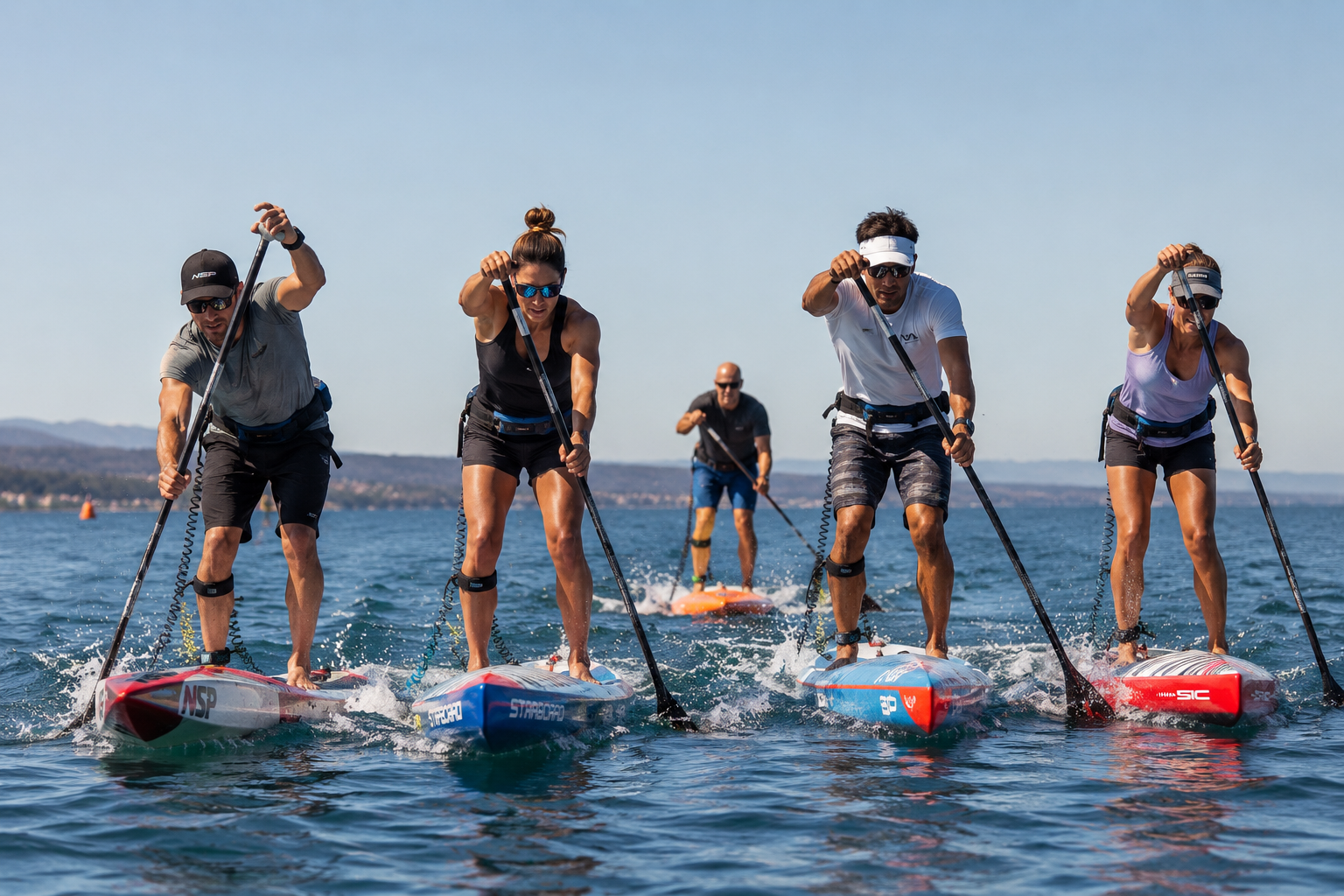
You're paddling along, feeling pretty solid, and then a guy on a 14-foot bullet blows past you like you're standing still. He's low, locked in, and gone before you can even process what just happened. And somewhere in that moment, a little voice says, "I want to do that." Or maybe it says, "What is wrong with that person." Both are valid responses.
SUP racing has a way of sorting people out pretty fast. Some paddlers catch the bug and never look back. Others try one race, decide they prefer their Sunday morning flat water cruise, and go home happy. Neither outcome is wrong. But if you're curious whether racing is your thing, here's an honest look at what it actually involves.
What Racing Actually Looks Like
SUP racing covers a pretty wide range. There are short technical races with buoy turns and sprint finishes, distance races that run anywhere from three to twelve miles or more, and downwind runs where you're chasing ocean swells and hoping you picked the right day to be brave.
Most local races are beginner-friendly and genuinely low-pressure. You show up, you paddle hard, you finish. Nobody's checking your stroke rate or judging your board. At the competitive end, things get more serious, but you'd know if you were at that level.
The thing that surprises most newcomers is how much fun it is even when you're slow. Racing gives your paddling a point. A finish line has a way of making every stroke feel like it matters.
What You Actually Need to Be Ready
You don't need to be fast. You need to be competent. There's a difference.
Comfortable on your board in open water, able to hold a steady paddle cadence for more than ten minutes, and confident enough to make a buoy turn (a pivot turn where you swing the nose around a marker) without swimming. Even a buoy turn is not mandatory, you can always take it nice and wide. That's the recommended baseline. Everything else you'll develop by doing it.
One thing worth knowing: board length matters more in racing than recreational paddling. A longer, narrower race board is faster but less stable. If you've only ever paddled a wide all-around board, your first time on a 14-foot race board will feel like balancing on a very expensive pool noodle. It gets better quickly, but plan for a learning curve. Click here to see our Race Board Recommendations.

keep this newsletter free and shop paddling apparel with this link
The Real Reason People Get Into Racing
It's not usually about winning. Most people who get into racing do it because it gives their paddling structure and community at the same time.
Training with a goal in mind changes how you paddle. You start paying attention to your catch (where your blade enters the water), your exit (where it leaves), your body rotation, your pacing, your breathing, your stance. You improve faster because you have a reason to improve.
And the race community, at the local level especially, is legitimately good people. You'll find paddlers who will lend you gear, give you tips mid-race, and still beat you to the finish. That last part comes with the territory.
How to Actually Find Out
Sign up for a local race. One. You don't need to train for months first. Check www.paddleguru.com for you local race options.
Look for a beginner or recreational division, because most races have one. Show up, use whatever board you already own, and just paddle. You will not be last forever. You might be last that day, and that's completely fine. First races are about finishing and figuring out if you want to do another one.
A few things that help before your first race:
Practice paddle cadence on flat water for 20 to 30 minutes without stopping
Find a buoy or dock and practice pivot turns until they feel natural - how to do a buoy turn
Know the course before the start horn goes off
That's really it. The rest you'll learn on the water.
Racing won't turn you into a different paddler overnight, but it will show you things about your paddling you didn't know were there. If you've been paddling recreationally and wondering what's next, a local race is a pretty good answer. Worst case, you paddle hard for an hour and grab a post-race breakfast with people who also love being on the water. There are worse ways to spend a Saturday.
