
So You Want to Go Fast…
A Guide to Your First Race-Style SUP
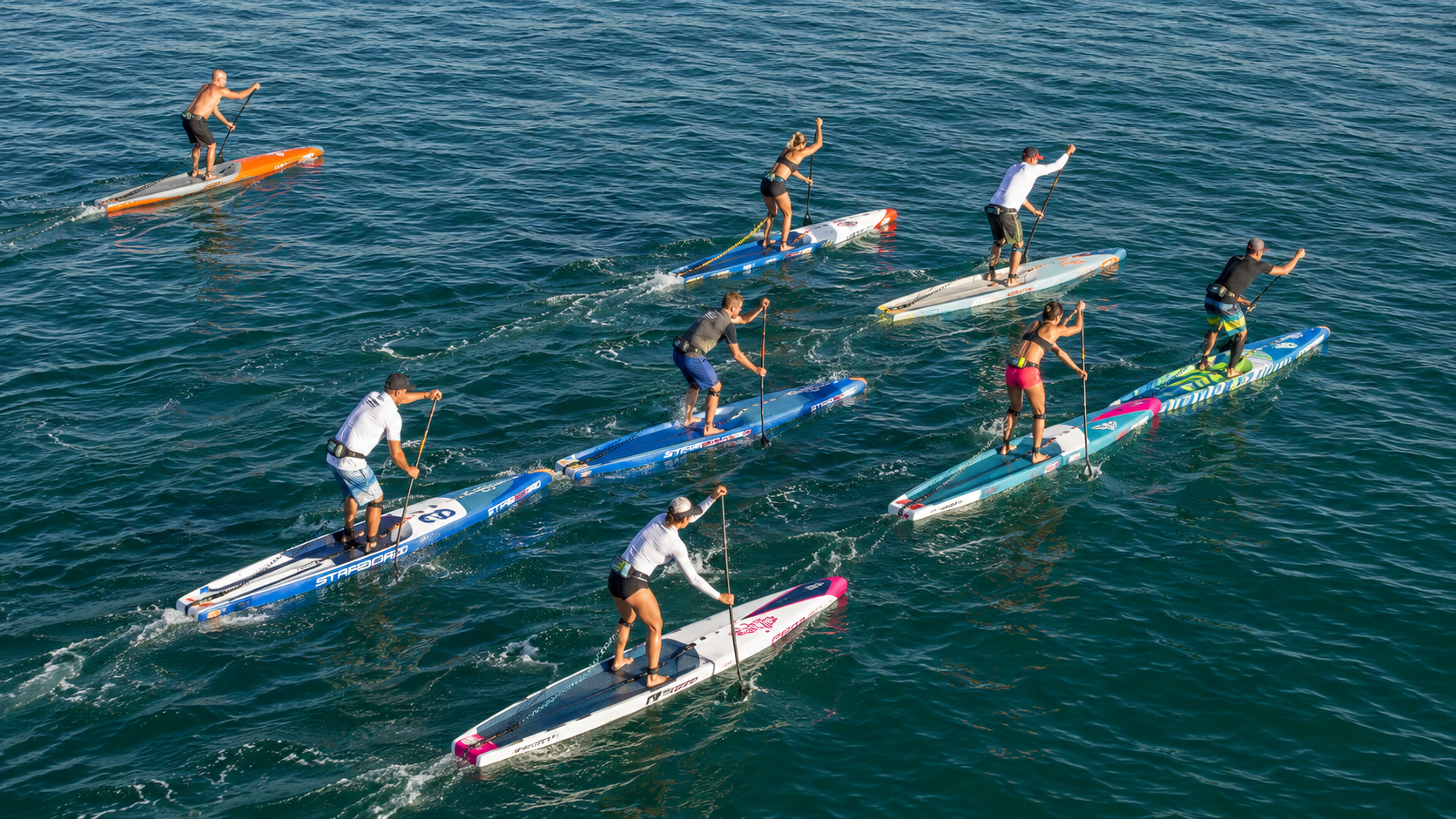
A few years back, I had a friend who'd been paddling a wide, stable all-arounder for two seasons. Comfortable, confident, never once fell in. Then she watched a local fun race go by, all those long narrow boards slicing past her like she was standing still, and came to me the next week saying she wanted to try it. Not to win anything. Just to see what it felt like to actually go fast for once.
This article is for those people. You're not trying to make USASUP nationals. You just want a board that rewards a strong stroke, and maybe you want to line up at a local fun race and see what you've got. Good news: that board exists, and you don't need to buy what the elite racers use to get there (although you may want to).
Race Boards vs. Touring Boards: What's Actually Different
Quick clarification before we go further, because these two get lumped together and they're not the same thing.
Race boards are built for one job: speed.. Narrow, often 24 inches or less on the competitive end, with minimal extras and very little forgiveness if your balance is off. Touring boards are the more sociable cousin. Still long and still narrow by general all-around SUP standards, usually landing in that 27 to 29 inch range, but built with enough width and cargo capacity that you can throw a dry bag on the nose and paddle for three hours without your legs shaking.
For someone coming off a classic all-around board, here's the honest truth: you almost certainly want something on the touring end of that spectrum, or a race board on the wider side of its range. A 22.5-inch race board will dump you in the water and sour you on the whole idea before you've even found your rhythm. A 28 to 30 inch board will still feel like a rocket compared to what you're used to, but it'll let you build the skill to get there instead of punishing you for trying.
Race Boards: Built to Go Fast
These are boards for paddlers who've committed to racing, even if "competing" just means showing up to a local fun race and giving it everything they've got. They're narrow, efficient, and unforgiving of lazy technique. That's the point.
Flying Fish Board Co. — Custom Race Board (Freedom Pro or Freeglide V2)
Average price: $3,200–$4,800 depending on specs and options
Flying Fish is a small custom shop out of Stuart, Florida, building handcrafted carbon race boards one at a time. That matters because you're not picking a board off a shelf: you're specifying your length, width, thickness, and volume based on your body and the conditions you paddle in. Their flagship race shapes are the Freedom Pro, a versatile all-water board that performs in both flatwater and ocean conditions, and the Freeglide V2, which is tuned more specifically for flatwater. Both have legitimate podium finishes at the national level.
The custom process is what sets Flying Fish apart from every other brand on this list. If you've spent enough time paddling to know what conditions you race in and roughly what volume you need for your weight, this is the most dialed-in board you can buy. The tradeoff is lead time of several weeks and the absence of third-party independent reviews you can lean on before buying. You're mostly going on customer testimonials and word of mouth, which are overwhelmingly positive, but it's worth knowing you're buying on reputation and a conversation with the builder rather than a test paddle at a demo day.
Infinity Blackfish and Everready — The All-Water Race Standard
Average price: $3,200–$4,500
The Blackfish has been winning races since 2014 and has earned that reputation the hard way: world titles, ISA gold medals, flatwater sprints, and ocean races under the feet of Candice Appleby, Kai Lenny, and a roster of top athletes who could paddle anything they wanted. The 2025 version gets a redesigned nose that's taller, sharper, and pulled in to a point, improving upwind efficiency without giving up flatwater glide.
What reviewers consistently note is how the Blackfish behaves off the start line. The planning hull design skips the board up onto the water quickly, generating acceleration faster than boards with traditional displacement hulls. It's available in both a flat deck and a dugout version: the flat deck offers a wider stance and is preferred for surf and rough conditions; the dugout lowers your center of gravity for flatwater sprints and technical buoy races. Widths range from 21.5 to 27 inches across the lineup, so you can choose how much stability you're willing to trade for speed. For a paddler getting serious about racing who wants a board they won't outgrow, this is one of the most respected shapes on the water.
SIC Maui RS — The Workhorse with a Winning Record
Average price: $2,500–$4,000
The RS won SUPConnect's Race Board of the Year award multiple times in a row, and the reason is simple: it's fast in every condition, not just on a glassy lake. The recessed deck lowers your center of gravity without sacrificing the feel of the rails underfoot, and the nose shape was refined to punch through chop upwind without losing top-end speed on the flat. Widths run from 21.5 to 28 inches across 12'6" and 14-foot lengths, which means there's an RS for almost every skill level and body type.
One dealer that has raced this board for years and put real finishing times on it put it plainly: the RS is fast enough to win and forgiving enough to enjoy on a normal training day. That combination is harder to find than it sounds. If you want a hard board with genuine race pedigree that doesn't punish you every time conditions turn choppy, the RS has earned its position in this category.
Red Paddle Co 14' x 28" Elite — Best Inflatable Race Option for the Non-Professional
Average price: $1,500–$1,800
Not everyone wants to strap a carbon board to a roof rack and baby it in the parking lot after a race. The Red Paddle Co 14' Elite is the inflatable answer to that problem, and it's a serious one. Built with MSL 800 double-drop-stitch material, fiberglass RSS stiffening battens, and a carbon FFC nose rod, it's engineered specifically to fight the flex that makes most inflatables feel soft under a hard stroke. At 28 inches wide and 14 feet long, it sits at the wider end of the race class, which for a transitioning paddler is an advantage, not a compromise.
Red Paddle Co claims this is the fastest inflatable on the market in the 14-foot class, and independent reviewers haven't been able to knock that claim down. The board comes ready for racing: forward handles for beach starts, bungee storage, and a race fin. It rolls up small enough to check as airline luggage, which matters if you're traveling to compete. For someone committed to racing but not ready to commit to a hard board, this is a legitimate choice, not a consolation prize.
Niphean Pro Racing 14' — The Budget Option (With Eyes Open)
Average price: $500–$700
Here's where I'll be direct with you: Niphean is an Amazon-forward brand that sells direct to consumers and doesn't have the racing pedigree or independent testing behind it that the other boards on this list do. The main review of the Niphean 14' Racing comes from a brand-sponsored test, and even that tester was new to race boards, which makes it hard to benchmark against anything. The board is spec'd at 14 feet by 25 inches, uses dual-layer PVC with carbon rail reinforcement, and comes with a full accessory kit at a price point that's less than half of a Red Paddle Co Elite.
What you're getting is a race-shaped board that will almost certainly feel dramatically faster than your old all-arounder, which for some people is all they need. If you're paddling a local lake, entering your first event with friends, and want to spend $600 instead of $1,500 to find out if you actually like racing, the Niphean clears that bar. What it won't do is give you the stiffness, construction quality, or verified performance of the premium options. Buy it knowing that, and it's worth every dollar. Buy it thinking it competes with a Blackfish or SIC RS, and you'll be disappointed.

keep this newsletter free by using this link for your paddling apparel
Touring Boards: Distance First, Speed as a Side Effect
Touring boards are for the paddlers who care more about where they're going than how fast they get there, though the two aren't mutually exclusive. These boards are wider, carry more gear, and ride more comfortably over long distances. They also might be the smarter first step for anyone transitioning off an all-arounder who isn't quite ready to commit to a narrow race shape.
Infinity E-Ticket — Performance Touring Built on Blackfish DNA
Average price: $1,900–$2,200
If you've been eyeing the Blackfish but want something with wider widths and a little more forgiveness in the balance department, the E-Ticket is exactly that. Designer Dave Boehne described it simply: it's for someone ready to move past entry-level shapes who wants performance construction and great speed in a board that's still genuinely easy to paddle. The 12'6" model measures 29.1 inches wide and uses a carbon Innegra glass sandwich construction with a recessed standing deck that drops your center of gravity without going full dugout.
Independent testing found the E-Ticket faster than comparable touring boards in its price range, including the Starboard Generation and the SIC Okeanos, while carrying its speed well even after you stop taking strokes. The slightly rockered nose handles chop without pitching you forward, and the wide tail keeps the board stable. It's not the easiest board in the world to turn, which is exactly what you want in something you're paddling in a straight line for hours. For a paddler ready for real performance without buying a pure race board, this is among the best values in hard touring boards.
Earth River SUP Dual 12-6 GT — Best Inflatable Touring Board for Real Distance
Average price: $1,300–$1,600
I flagged the 32-inch width earlier in this post and I'll flag it again here: this is not a race-width board. It sits outside the 24 to 29 inch window that defines the race and performance touring category. What it is, however, is one of the finest inflatable touring boards built, and for a paddler whose priority is covering serious distance with gear on board rather than racing anyone, that matters more than the width spec.
The Dual GT uses ERS's proprietary dual-core construction with reinforced key stress areas, keeping the board stiff enough to glide properly under load. The fin system gives you four center fin options and two sets of side click fins, so you can tune it for flatwater tracking or more responsive open water handling. Reviewers consistently describe it as a dream to paddle: efficient, predictable, and capable of handling combined weight up to 350 pounds without compromising its feel. The 32-inch width means you can actually bring a cooler, a dry bag, and a kid without the board turning into a barge. If touring is the goal, don't let the width number talk you out of the right board.
Thurso Expedition 150 12'6" — The Smart Buy for Paddlers Who Want to Cover Ground
Average price: $800–$1,100
At 31 inches wide, the Thurso Expedition 150 is also wider than a pure race-touring shape, and that's worth acknowledging. It is one of the best-reviewed inflatable touring boards under $1,100 on the market, and for a paddler stepping off an all-arounder and into distance paddling, it's a genuinely compelling entry point.
Reviewers consistently praise its tracking, calling it one of the most directionally stable boards in its price class, which is exactly the quality that separates a touring board from a board you just paddle fast. One tester who normally paddles a 28-inch board called it incredibly stable in wind gusts and moderate chop, and relatively fast for an inflatable at this price. The 2025 model added a new 4.7-inch thickness option that lowers the center of gravity and improves stability for paddlers under 200 pounds, while the 6-inch version retains better stiffness for heavier paddlers or those who push hard stroke rates. It comes with a full kit including a carbon hybrid paddle, backpack, leash, and pump, and the accessories are actually good enough to use rather than immediately replacing. For the price, very little comes close.
Bottom Line
If you're ready to race, the Infinity Blackfish or SIC Maui RS are the hard boards that earn their price. The Red Paddle Co 14' Elite gives you genuine race performance in an inflatable without the car rack. Flying Fish is the answer when you've figured out exactly what you need and want it built for you. The Niphean is fine if you're testing the waters on a limited budget and know what you're buying.
For touring, the E-Ticket is the performance pick if you want a hard board with real speed. The Earth River Dual GT is the inflatable to beat if distance and gear capacity matter more than width specs. And if you're stepping up for the first time without wanting to spend $2,000, the Thurso Expedition 150 will make you a believer in what a long touring board can do.
See you on the starting line.
