
The Best Thin Wetsuits for Fall Paddling
The water gets cold way before you're ready to admit summer is over. Air temps are still hitting 70, the sun's out, and you head down to launch in a t-shirt like it's July. Then you touch the water and it's a different season entirely. That gap between air temp and water temp is exactly what gets paddlers in trouble every fall, and it's exactly what a thin wetsuit top solves.
You don't need a full 4/3 winter suit for this. That's overkill, it'll cook you, and it'll wreck your paddle stroke. What you need for most fall paddling is something thin: 0.5mm to 2mm neoprene on top, maybe a bottom layer if you're paddling somewhere the water's really dropped off. Here's how to think about it and what to actually buy.
Why a Thin Wetsuit Top and Not Just a Jacket
A rain jacket or windbreaker keeps wind off you. It does nothing once you're wet, and if you fall in, it does nothing at all. Neoprene insulates even when it's soaked, because it traps a thin layer of water against your skin and your body heats that layer up. That's the whole trick. A thin wetsuit top gives you that insulation without turning your paddle session into a sweat lodge, since fall days still have warm stretches even when the water's gone cold.
The other reason this matters more in fall than almost any other season: you're most likely to fall in during shoulder season. The water's choppier, the wind's picking up, and you're paddling less often so you're rustier. Plan for the swim, not just the paddle.
Short Sleeve or Long Sleeve?
Short sleeve works if you're paddling in moderate conditions and want full arm mobility for your stroke. It's the more popular choice for SUP specifically, since a full range of motion in your shoulders and arms actually matters when you're paddling for an hour.
Long sleeve makes sense once the air temp drops enough that your arms are cold even while you're working, or if you're paddling in more exposed, windy conditions where extra coverage counts. If you run cold or you're paddling early morning sessions before the day warms up, long sleeve is the smarter call.
Either way, the core stays covered, and that's what actually matters for keeping your body temperature up if you end up in the water.
The Rule of 120
A quick gut check for whether you need one of these at all: add the air temperature and the water temperature together. If the total is under 120, you need thermal protection. I'll dig into this a lot more in a separate article with a full breakdown, but that number alone is a good enough test to know if today's the day you actually wear the thing sitting in your gear bag.
Do You Need Bottoms Too?
For most people, a thin top handles fall paddling on its own, especially if conditions are calm and you're not expecting to spend real time in the water. But once water temps drop into the 50s, or you're doing anything where a swim is more likely (river paddling, choppy open water, teaching lessons), a thin bottom layer is worth adding. You lose a lot of heat through your legs and glutes sitting or kneeling on a board, and a 0.5mm to 1mm bottom paired with a top gets you real core-to-leg coverage without the bulk of a full suit.
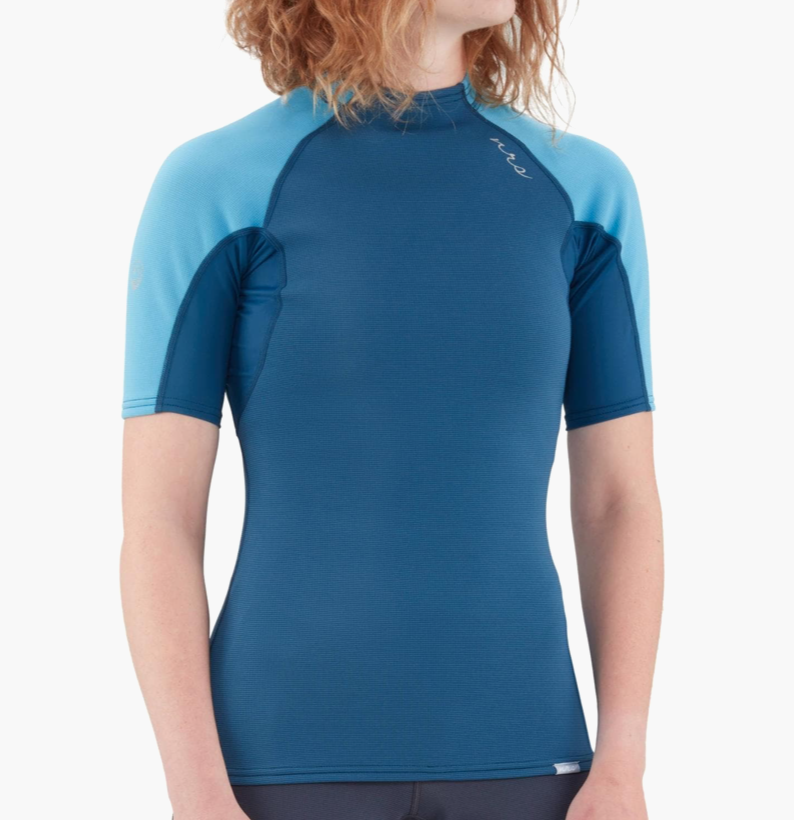
NRS .5 HydroSkin Top
This is the standard for a reason. NRS built this specifically for paddlers, not surfers or divers, so the cut and seam placement are made for the stroke instead of just generic water sports. It's 0.5mm Terraprene neoprene with a heat-reflecting titanium lining, four-way stretch, and rashguard panels under the arms so you don't overheat the second the sun comes out. It's a thin, splash-and-swim layer, not a submersion suit, which is exactly the category most fall SUP days call for. Runs $99 to $120 depending on retailer and whether you catch a sale.
O'Neill Reactor-2 1.5mm Long Sleeve Pullover Wetsuit Top
If you want more warmth than the HydroSkin without stepping up to a full wetsuit, this is the move. O'Neill's UltraFlex neoprene is genuinely flexible for a 1.5mm suit, it's got a boardshort connector so it won't ride up mid-stroke, and the pullover design means one less zipper to worry about. It's built with surfing and paddleboarding specifically called out, and at around $70 to $90 on Amazon it's one of the better value picks on this list.
LayaTone 2mm Wetsuit Top (Men's and Women's)
LayaTone zones the thickness smartly: warmer 2mm neoprene through the core, thinner stretch panels through the sleeves, so you get the warmth where you need it without losing arm mobility. YKK zipper, decent anti-chafe detailing, and it's priced well under $50 on Amazon, which makes it a solid budget pick if you're not paddling several times a week and don't want to drop $100+ on a top you'll wear a dozen times a season.
Bottom Line
Don't overthink this. If you're a regular fall paddler, a thin wetsuit top is one of the cheapest pieces of safety gear you'll ever buy, right up there with a leash and a PFD. Get one that fits snug (loose neoprene doesn't work, water just flushes through it), match the thickness to how cold your water actually gets, and check the Rule of 120 before you decide you don't need it today.
